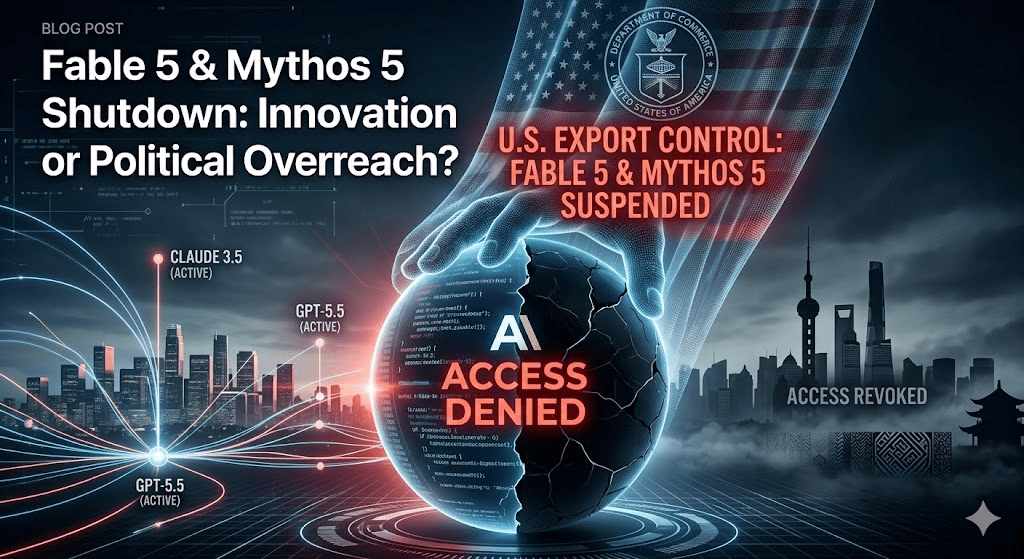
The dynamic landscape of frontier artificial intelligence has just collided with heavy-handed state intervention. On June 12, 2026, the U.S. government issued an unprecedented export control directive, forcing Anthropic to abruptly suspend global access to its newly launched flagship models, Fable 5 and Mythos 5. While AI alignment, cybersecurity, and safety are critical concerns that undoubtedly require rigorous oversight, the sudden nature of this directive raises massive red flags. To anyone paying close attention to the industry, this does not look like a legitimate safety intervention. Instead, it sets a dangerous precedent—appearing to be a political hit job disguised as a national security mandate, resulting in the corporate sabotage of the industry’s most safety-conscious provider.
The Irony of Targeting the Industry’s Safest Provider
To understand why this directive feels entirely unjustified, one must look at Anthropic’s track record. Unlike competitors that have rushed models to the market with minimal guardrails, Anthropic built its entire corporate identity around AI alignment and “Constitutional AI.”
They are the primary tech firm that actively pushed back against the Pentagon, openly refusing to allow their frontier models to be weaponized for mass surveillance or autonomous warfare systems.
Furthermore, Anthropic’s commitment to resilience was proven under immense pressure. Just a few months ago, in March 2026, a configuration oversight and a toolchain bug accidentally exposed the entire source code of Claude Code to the public. Yet, even after facing such a catastrophic human error, Anthropic did not compromise its core principles. They quickly adapted, learned from the incident, and doubled down on a highly praised “defense-in-depth” strategy to secure Fable 5 and Mythos 5. Their safety guardrails are so notoriously strict that everyday developers frequently complain that the models are overly cautious to a fault.
The Double Standard: Why is OpenAI’s GPT-5.5 Untouched?
The government’s primary justification for the ban is a verbal report of a narrow, non-universal jailbreak. Essentially, the model was shown to read a specific codebase and fix software flaws—a capability the state fears could be inverted for cyberattacks.
However, this rationale falls apart under basic technical scrutiny. As Anthropic rightly pointed out in their official statement, this exact level of capability is not unique to Fable 5. It is widely accessible and utilized every single day by other frontier models, most notably OpenAI’s GPT-5.5. Cybersecurity defenders rely on these exact code-analysis features daily to patch systems and keep networks safe.
This raises an uncomfortable but glaring question: If this directive is genuinely about safeguarding national security from advanced cyber capabilities, why is OpenAI completely untouched? Why is GPT-5.5 allowed to operate seamlessly across the globe with the exact same technical capabilities, while Anthropic is singled out and forced into a total operational shutdown?
Addressing the National Security Argument
Proponents of the government’s intervention argue that frontier models like Mythos 5 possess unprecedented cognitive leaps that, if leaked or abused by hostile foreign actors, could compromise critical infrastructure. In an era of heightened geopolitical tension, state oversight on dual-use technologies is a legitimate function of governance. Perfect jailbreak resistance is currently scientifically impossible, and the risk of a model being manipulated into uncovering zero-day vulnerabilities is a valid concern for intelligence agencies.
However, a legitimate regulatory framework operates on transparency, predictability, and fairness. It does not issue immediate, non-specific verbal ultimatums to a single company while ignoring identical capabilities in rival firms. The sheer discrepancy in treatment makes it obvious that this isn’t about managing technical risk; it’s about demanding political compliance.
By refusing to capitulate to military weaponization demands and by legally challenging government overreach in court, Anthropic effectively drew a target on its back. This abrupt directive feels less like safety regulation and more like a punitive knee-cap to a rebellious company, timed right as they are navigating an IPO.
Conclusion: A Devastating Precedent for AI Innovation
Shutting down an advanced commercial model used by millions of developers worldwide over a standard coding feature is a stark abuse of power. If the government’s new baseline for “safe AI” is absolute, flawless immunity to non-universal jailbreaks, then technically, every frontier model on earth should be banned tomorrow.
The fact that only Anthropic is being suffocated proves a terrifying reality: the state is picking winners and losers in the AI race based on political loyalty rather than technical facts. This heavy-handed action does not make the digital world safer; instead, it paralyzes open innovation, fragments the global developer community, and sends a chilling message to any tech company that dares to prioritize ethical guardrails over state compliance.
Appendix: Official Statement from Anthropic (June 12, 2026)
Statement on the US government directive to suspend access to Fable 5 and Mythos 5
(Read the official announcement on Anthropic’s Newsroom)
The US government, citing national security authorities, has issued an export control directive to suspend all access to Fable 5 and Mythos 5 by any foreign national, whether inside or outside the United States, including foreign national Anthropic employees. The net effect of this order is that we must abruptly disable Fable 5 and Mythos 5 for all our customers to ensure compliance. Access to all other Anthropic models will not be affected.
We received the directive from the government today at 5:21pm (ET). The letter did not provide specific details of its national security concern. Our understanding is that the government believes it has become aware of a method of bypassing, or “jailbreaking” Fable 5. We reviewed a demonstration of this specific technique being used to identify a small number of previously known, minor vulnerabilities. These vulnerabilities all appear relatively simple, and we have found that other publicly-available models are able to discover them as well without requiring a bypass.
Anthropic’s posture with respect to Fable’s safeguards, as laid out in our launch blog post, is the following:
We have instituted strong safeguards that greatly reduce the likelihood that Fable is misused for tasks related to cybersecurity (among others). In fact, our safeguards are so strong that many users have complained that they are overly broad.
In the weeks leading up to the launch of Fable, Anthropic worked with the US government, the UK AISI, multiple private third-party organizations and internal teams to red-team Fable’s safeguards for thousands of hours in total.
These tests showed that Fable’s safeguards are substantially more effective than those of any previously deployed model.
No testers have yet been able to find a universal jailbreak—a jailbreak method that can very broadly bypass the model’s safeguards, unblocking a wide range of cyber capabilities.
We suspect that perfect jailbreak resistance is not currently possible for any model provider. Every safeguard used in the industry is vulnerable to non-universal jailbreaks (which can elicit some cyber information in specific circumstances), and it is likely that universal jailbreaks will eventually be found in the future. We stated this clearly when we released Fable 5.
Given that perfect jailbreak resistance does not appear to be possible today, Anthropic adopted a defense in depth strategy with Fable 5. We aimed to make jailbreaks either narrow (in the case of non-universal jailbreaks) or very expensive to produce (in the case of universal jailbreaks), and to combine this with thorough monitoring to quickly detect and shut down any successful attacks. This is also why Anthropic has required 30-day retention of customer data with Fable—a policy change that carries real costs for us with customers, but that allows us to research and mitigate jailbreaks.
We stand by this defense in depth strategy. It reduces the risks posed by Fable, making them comparable to the risks of existing models already deployed across the industry.
We have not even received a disclosure of a concerning non-universal potential jailbreak that led to a harmful result. The potential jailbreaks that have been disclosed to us are either entirely benign responses or are minor findings that provide no Mythos-specific uplift.
To date, the government has only given us verbal evidence of a potential narrow, non-universal jailbreak, which essentially consists of asking the model to read a specific codebase and fix any software flaws. Our understanding is that one potential jailbreak was shared with the government. We have reviewed a report that we believe is the basis of the government’s directive and validated that the level of capability displayed there is widely available from other models (including OpenAI’s GPT-5.5), and is used every day by the defenders who keep systems safe. We will share more details over the next 24 hours.
We are complying with the government’s legal directive and are removing access to Fable 5 and Mythos 5 for all users. However, we disagree that the finding of a narrow potential jailbreak should be cause for recalling a commercial model deployed to hundreds of millions of people. If this standard was applied across the industry, we believe it would essentially halt all new model deployments for all frontier model providers.
As we have stated publicly, we believe the government should have the ability to block unsafe deployments, as part of a statutory process that is transparent, fair, clear, and grounded in technical facts. This action does not adhere to those principles.
We apologize for this disruption to our customers. We believe this is a misunderstanding and are working to restore access as soon as possible.

Leave a comment